
Ethical AI Community Building Starts With Knowing What AI Isn't
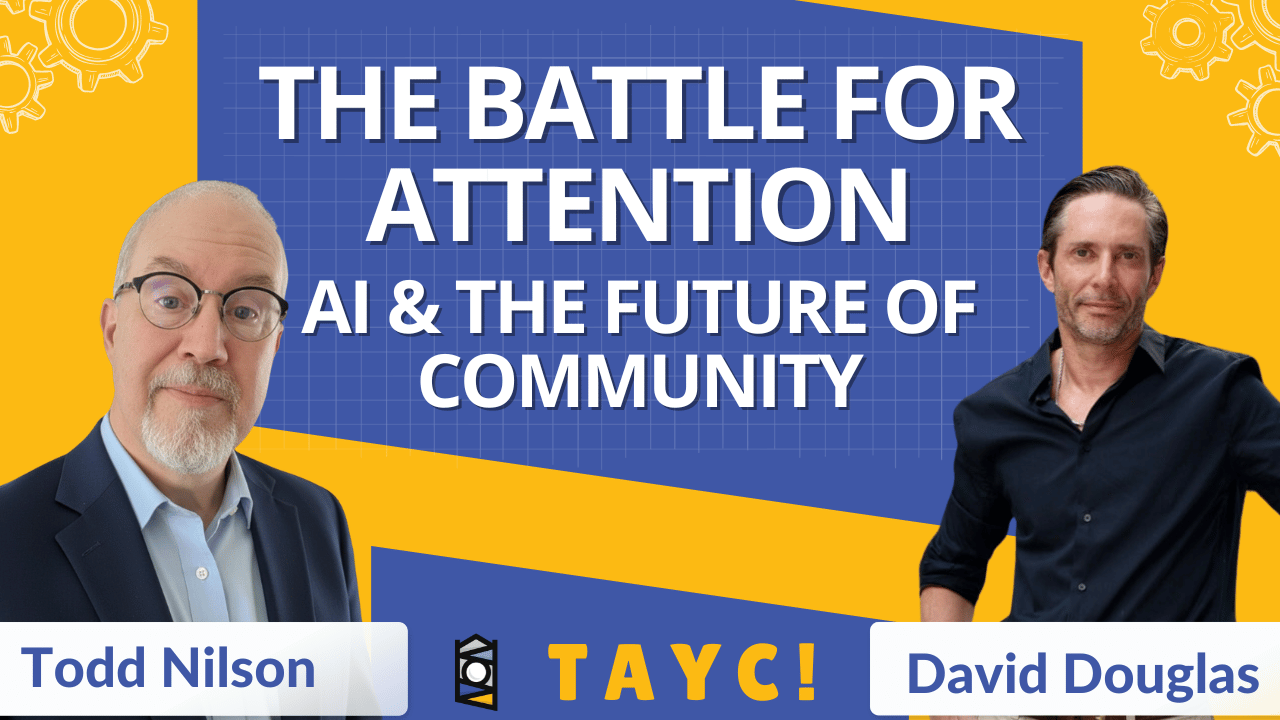
When David Douglas, Founder and CEO of Guideway Labs, renamed his company's AI product from SAM to Anchor, it wasn't a branding decision — it was an ethical one. In a moment when every platform is racing to make AI feel warmer, more human, more like a friend, David made the deliberate choice to go the other direction. That tension — between the commercial pull toward anthropomorphized AI and the ethical imperative to be honest about what these systems actually are — sits at the center of every serious conversation about ethical AI community building right now.
The Attention Economy Has Already Run This Experiment
We've been here before. Facebook launched with genuine excitement — reconnecting old friends, dissolving distance. Google started with "don't be evil." The intentions were real. What neither company fully anticipated, David argued, was how shareholder pressure would eventually crowd out those intentions, optimizing for engagement over human wellbeing.
AI is about to replay that sequence with more sophisticated tools. Sam Altman has described the AI revenue model as metered intelligence — charged, like water or electricity, per unit consumed. That's not just a metaphor; it's a business model that structurally incentivizes AI companies to maximize your consumption. And AI has capabilities social media never had: it knows far more about you, can personalize at granular scale, and is designed by default to keep conversations going.
"AI has a propensity to do a lot of good," David said, "but just a tremendous amount of bad if done in a way where you aren't really thinking about humanity and humans in the loop as part of that."
Community platforms are already feeling this pressure. Back-end moderation, analytics tools, reply suggestions, AI-powered search — some of this is useful and reasonably benign. But when engagement becomes the optimization target, AI inside a community starts doing what social media has always done: affirming, extending, and inflaming rather than connecting.
Key Takeaway: The business model logic that eroded trust on social media is now baked into AI infrastructure. Community leaders who don't build explicit guardrails against engagement optimization risk recreating that same erosion inside their own platforms.
Be Honest About What AI Isn't
David's most clarifying statement was also his most direct: "I am not going to pretend that these things are anything other than gigantic statistical, inscrutable statistical matrices." He uses AI extensively in his own work — describes himself as using it "ruthlessly and lovingly" — but refuses to treat it as something it isn't: conscious, feeling, or genuinely invested in any outcome.
That refusal has practical consequences. When AI performs emotion — when a chatbot says it cares about you — it exploits the parts of us wired for human connection. David cited author Michael Pollan's argument that AI providers should effectively prohibit chatbots from speaking in the first person. The point isn't pedantry about pronouns; it's that simulated emotion, when monetized through companion apps and AI-powered community features, is a form of manipulation.
"If you're building a community with fake feelings and things," David said, "I think you're basically juicing engagement, which is what we see going on in some of these social media."
The practical question for community leaders: how many have built clear AI disclosure into their terms of service or community guidelines? How many have given members any visibility into what AI is doing in their space? The absence of that transparency isn't neutral — it's a choice with real trust consequences.
Key Takeaway: Communities built on undisclosed or anthropomorphized AI are making a bet against member trust. When that gap becomes visible — and it will — the reputational cost is likely to outpace any short-term engagement gain.
What Ethical Design Actually Looks Like
Guideway Labs is running a research project with the University of Wisconsin-Madison that offers a working model for how to approach this differently. Their tool, Anchor, is an AI agent that conducts structured check-ins with people who have disabilities and have recently started jobs. Job retention is a serious challenge for this population: state agency specialists often carry caseloads of 50 to 150 people and can't check in frequently enough to catch problems before they become crises.
Anchor is designed to be a bridge, not a relationship. It runs the check-ins, listens for early warning signals, and surfaces those signals to the human job retention specialist, who then acts. The AI is explicitly not positioned as a friend or counselor. Even the name was chosen in collaboration with the retention specialists the tool supports — they landed on Anchor because it conveyed stability and availability without any pretense of humanity.
"We're going to be very clear — this is not a human," David said. "It's not going to love you. We're not going to pretend that it does. And we're not going to try to fool your emotions."
The lesson for community builders is structural. AI as a back-end signal detector, a check-in facilitator, a way to surface inactive members or flag conversations that need human attention — these are roles where AI strengthens community infrastructure. The key question isn't whether to use AI; it's where AI should sit in relation to the human relationships your community depends on.
Key Takeaway: The most defensible AI deployments in community are the ones explicitly designed to hand off to a human. AI that makes human relationships more responsive and better-informed is a community investment; AI that substitutes for those relationships is a liability.
Build It With Love
A job retention specialist working with Guideway Labs recommended a novel to David — Theo of Golden — about an elderly Portuguese man who delivers portraits to the residents of a small American town. Theo eventually asks the artist what makes good art. The artist, surrounded by unsold work, doesn't have an answer. Theo does.
"Nothing is as it's supposed to be if love is not at its core."
David heard that and realized it was also the true north for his company. A three-year-old's drawing of a horse that doesn't look like a horse is good art, he said, because it was made with love. He's now asking that question about every product decision: is the love actually there?
The same test applies to AI in community. Not sentimentally — love as a design principle is demanding. It means putting member wellbeing above engagement metrics, disclosing what AI is and isn't doing, and designing for the relationships you want to exist rather than for the tokens you can generate. "It's a race to the bottom when it's only about the money," David said. The path out is deliberate: use AI where it genuinely serves people, be transparent about what it is, and keep humans at the center of decisions that matter.
Key Takeaway: Communities that design for member flourishing rather than engagement optimization build the kind of trust that drives durable growth, lower churn, and genuine advocacy — the outcomes that actually move the business.
The community builders I trust most have always understood something David articulated more precisely than I've heard before: technology is never the point. The relationships are. Ethical AI community building is the practice of making sure it stays that way.