WHEN A BETTER RESULT DOESN’T CHANGE THE STANDARD
What happens when a tool gets tested, employees want to use it, operators buy it—and the standard procedure stays the same?
I have spent 31 years living inside that question.
I invented the Heavyweight® Scrub Brush because I was trying to clean floors for a living, and the standard deck brush was backbreaking to use. It required me to bend over and supply the downward force needed to scrub a large restaurant floor. Machines were not a practical solution because they did not fit every situation.
So I created my own tool.
I put weight on the brush so the brush could supply the downward force. That allowed me to stand upright instead of using my back to force the brush into the floor. For the first time, I had a realistic chance of producing the result I wanted without destroying myself physically.
My first version was a crude weighted contraption, but it worked.
As I used it while cleaning, managers noticed. They wanted to try it. When we scrubbed floors people believed were clean, dark material came out. Employees who had mopped those floors wanted the brush and wanted to see what came out next.
KAY Chemical evaluated the brush. McDonald’s and AEGIS tested it in twenty restaurants and reported more thorough cleaning than the existing method. Operators bought thousands of them and used them successfully. Yet the basic floor-cleaning procedure did not change across the system.
Why?
Look at the procedure everybody already knows.
We start with clean water and cleaning solution. We dip the mop, clean part of the floor and wring it into the bucket. The water begins to cloud, then darken.
We see the dirty water and think: Good. We’re picking up the dirt.
Then we dip the mop back into that same water.
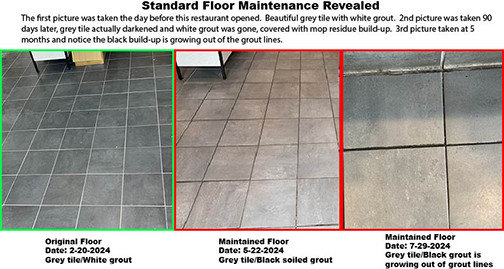
Now the mop carries a mixture of water, chemical and what came off the floor. We drag it across the next section of tile and grout. The floor’s texture scrapes some of that mixture from the mop and holds onto it.
As the bucket darkens, the mop acts more like a paintbrush. We wring, dip and mop again, putting that mixture back onto the floor while taking the dark water as proof of cleaning.
We can see what went into the bucket. We need to look at what comes back out.
Employees have been doing the job with the tools they were given. The procedure gets completed, yet the floor keeps changing. Grout becomes dark so gradually that the altered floor looks normal.
Cleaning happened. Did cleaning work?
That is the question I want researchers, students and operators to test. Measure what is in the bucket after each pass. Measure what the mop carries onto the next section. Measure what remains in the floor’s texture. Compare the floor before cleaning, afterward and after repeated cycles.
I will share my testing history and 31 years of field observations. Challenge my explanation. Compare other methods. Find something better than my brush if you can. The objective is to solve the problem.
And when a test produces a better outcome, ask another question: What has to happen before the standard changes?
In the meantime, the next time you enter a convenience store, gas station or public restroom—anywhere grout is routinely mopped—look down. What c