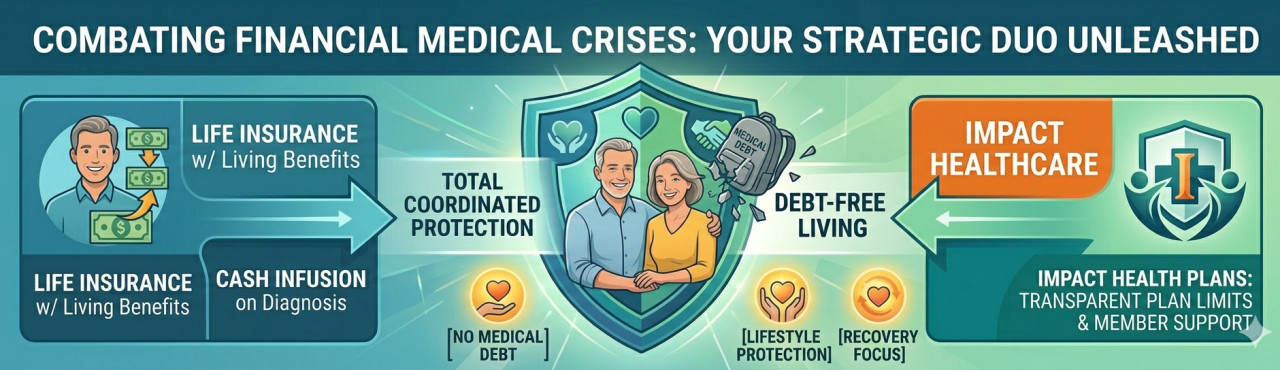


The Financial Safety Net: Life Insurance with Living Benefits
The Financial Safety Net: Life Insurance with Living Benefits
These are modern riders added to a life insurance policy (both term and permanent). They fundamentally shift the purpose of the policy. Traditional life insurance only benefits your family after you are gone; living benefits allow you to access a portion of your death benefit cash while you are still alive if you are diagnosed with a qualifying medical condition, such as:
A Terminal Illness: Diagnosed with a limited life expectancy (e.g., 12–24 months).
A Chronic Illness: Being unable to perform basic daily activities (e.g., bathing, eating) due to condition or cognitive impairment.
A Critical Illness: Suffering a major, specific event like a heart attack, stroke, or invasive cancer.
This payout is typically a lump-sum cash infusion paid directly to you, not the hospital. Its use is unrestricted.
2. The Medical Bill Ceiling: Impact Healthcare (Health Sharing)
Impact Health Sharing is a healthcare sharing ministry (HCSM), not traditional insurance. It is a non-profit community of members who voluntarily share one another’s eligible medical costs. It works by having members choose a Primary Responsibility Amount (PRA), which functions similarly to a deductible. Impact’s advantage is offering structured options with defined limits on what you will pay before the community shares 100% of the remaining eligible bills.
Lower PRA Options: While still higher than some expensive low-deductible insurance plans, Impact allows families to choose PRAs (often ranging from $2,500 to $10,000) to cap their known exposure.
Defined Co-Share & Maximum Out-of-Pocket: After the PRA is met, there is typically a co-share (a percentage you pay, usually 10%) until you hit a Co-Share Maximum (e.g., $5,000 annually per household).
The Ceiling: The combination of your PRA and your Co-Share Maximum represents the absolute ceiling on your direct exposure to eligible medical bills for the year.
How They Work Together Better Than Traditional Insurance
Traditional insurance is designed to protect hospitals and doctors from not being paid for allowable expenses. This strategic duo is designed to protect your household from the total financial shock that accompanies a major illness.
| Comparison Point | Traditional Insurance (HMO/PPO) | The Strategic Duo: Health Sharing + Living Benefits | Why the Duo Combats a Crisis Better |
| Direct Medical Bills | Protects doctors/hospitals. Has complex coinsurance and separate deductibles for drugs/facilities. Your MOOP may not cover everything. | Protects your community and you. The combination of your PRA + Co-Share Max creates a predictable, defined ceiling on your eligible medical bill liability. | Predictability. You know your exact maximum exposure for direct medical costs, eliminating surprise bills. |
| Personal Finances (Indirect Costs) | No coverage. You are responsible for replacing your income, paying your mortgage, and finding childcare while battling illness. | Lump-Sum Unrestricted Cash. The living benefit pays a substantial sum directly to you based on your diagnosis, not your bills. | Holistic Support. It provides the "Lifestyle Insurance" needed to survive the personal financial devastation of a major health event. |
| Eligibility/Coverage Gaps | Strict on "Medically Necessary" vs. "Allowable." Many modern or experimental treatments are denied. | Health Shares operate on guidelines, often offering greater flexibility for members to choose their own doctors and therapies, though they may have waiting periods for pre-existing conditions. | Greater Control. Health shares often allow you to seek the best, most cost-effective care without a network list or pre-authorization hurdle, particularly when coupled with cash. |
| Total Crisis Resilience | You must pay your high deductible and copays even if you aren't working. This is how people end up in medical debt. | The living benefit lump-sum cash pays for your PRA/MOOP. The duo eliminates the conflict of "do I pay the hospital or the mortgage?" | Debt Prevention. The duo ensures you don't use credit cards or take loans to cover deductibles or keep your household afloat. |
The Synergy in Action (A Scenario)
Consider a scenario to see the coordinated defense. A member household is diagnosed with invasive cancer.
THE DIAGNOSIS (THE CRISIS BEGINS): The family must stop working immediately for treatment. This is not just a medical problem; it is an income problem.
THE MEDICAL BILL DEFENSE (IMPACT HEALTH): The family’s health sharing plan has a PRA of $5,000 and a household Co-Share Max of $5,000. The family is responsible for the first $5,000 of bills, and then 10% co-share until they hit $10,000 total out-of-pocket for the year. Beyond that, the community shares 100% of eligible costs. Total Household Liability for medical bills is known: $10,000.
THE FINANCIAL CRISIS DEFENSE (LIVING BENEFITS): The life insurance policy has a $250,000 critical illness rider. Because cancer is a qualifying event, a cash lump sum of $100,000 (e.g., 40% of the death benefit) is paid directly to the family, tax-free.
THE COORDINATED VICTORY:
Action A: The family immediately uses $10,000 of the cash infusion to satisfy their PRA and Co-Share Max. This instantly pays off their direct medical liability.
Action B: The family uses the remaining $90,000 of unrestricted cash to replace their income for the next 12 months, pay their mortgage, maintain special diets, fund experimental treatment options, and cover counseling for their children.
Conclusion: Traditional insurance might have left this family $8,000 in deductibles with zero support to replace the $5,000 monthly income they lost, inevitably leading them toward medical bankruptcy or debt. This duo replaced financial panic with financial control, preventing debt and allowing the family to focus purely on recovery.