
The Hidden Crisis in Scientific Research — And Why It’s Time to Rethink Peer Review
By Nicole Kargin, Founder of ResearchDoc AI
Science is built on a simple promise: truth through verification.
But today, that promise is under pressure.
Across disciplines—from medicine to machine learning—researchers are confronting a growing reality: many published findings cannot be reliably reproduced. This is not a fringe issue. It’s what’s now widely known as the replication crisis—a systemic challenge that threatens the credibility of modern science.
And at the center of this issue lies a process we’ve long trusted: peer review.
The Problem: A System Under Strain
Peer review was designed to ensure quality, rigor, and trust. But in practice, it’s increasingly:
- Slow and inefficient
- Subject to bias
- Inconsistent in quality
- Overwhelmed by volume
In fact, research shows that peer review today is often “inefficient, biased, and ineffective,” despite being critical to research integrity.
Meanwhile, the scale of scientific output has exploded. Reviewers are overburdened, and important details are slipping through the cracks.
The result?
- Papers with flawed methodologies get published
- Critical data and code are often missing
- Errors go undetected until much later—if ever
Even more concerning: reviewers frequently miss fundamental issues in manuscripts, including unsupported conclusions.
The Reproducibility Crisis Is Real
Let’s be clear—this isn’t theoretical.
- Large-scale studies have shown that many scientific findings cannot be replicated
- In some fields, replication studies are rarely published at all due to publication bias toward positive results
- Entire domains, including AI and healthcare research, have been impacted by methodological errors and lack of transparency
In machine learning alone, hundreds of studies have been found to contain issues like data leakage, leading to inflated and misleading results.
This creates a dangerous cycle:
Publish → Trust → Build upon → Discover it doesn’t hold
And by then, the cost—in time, funding, and credibility—is enormous.
Why This Matters More Than Ever
Scientific research doesn’t exist in a vacuum.
It informs:
- Medical treatments
- Public policy
- Investment decisions
- Technological innovation
When flawed research passes through the system unchecked, the downstream effects can be profound.
Even public trust is at stake—studies show that awareness of reproducibility issues can reduce confidence in entire fields of science.
The Core Issue: A Paper-Based System in a Data-Driven World
At its core, today’s peer review system is still largely paper-centric.
But modern research is not just papers—it’s:
- Data
- Code
- Models
- Experimental workflows
And yet, reviewers are often asked to evaluate complex, data-heavy research without access to the full picture.
This disconnect is one of the biggest gaps in scientific validation today.
A New Opportunity: Reimagining Research Validation
This is where a new generation of tools—and thinking—comes in.
Imagine a world where:
- Research is evaluated beyond the PDF
- Data, code, and methodology are structured and verifiable
- AI assists reviewers by flagging inconsistencies and risks
- Reproducibility is not an afterthought—but a requirement
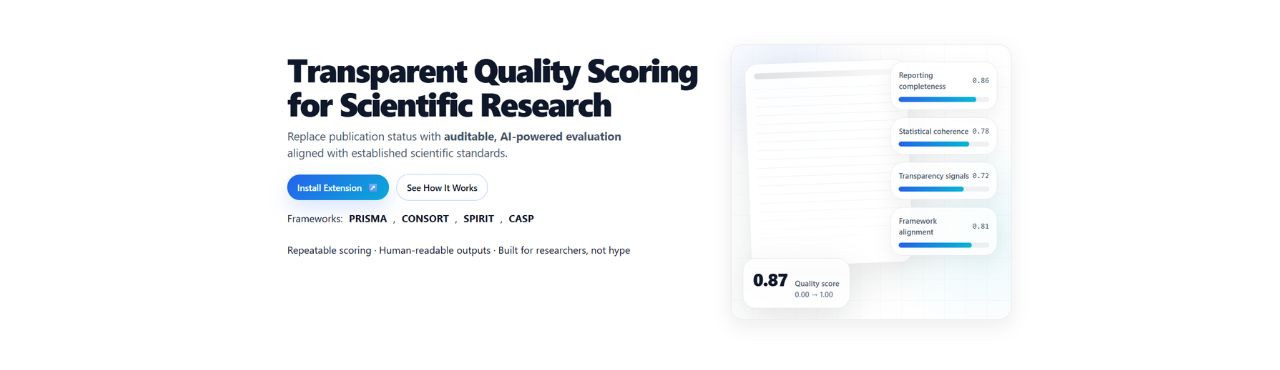
Emerging research shows that AI-assisted peer review systems can significantly improve efficiency, consistency, and overall research quality.
But technology alone isn’t enough.
We need a community-driven movement to rethink how research is created, reviewed, and trusted.
Enter ResearchDoc AI
At ResearchDoc AI, we believe:
The future of science is transparent, structured, and verifiable.
We’re building toward a world where:
- Research is easier to validate
- Reviewers are empowered—not overwhelmed
- Scientists can trust what they build upon
Because better research doesn’t just benefit academia—it benefits all of us.
Join the Movement
If you’re:
- A researcher tired of broken systems
- A reviewer overwhelmed by volume
- A founder building in AI or healthcare
- Or simply someone who believes science should be more trustworthy
We invite you to be part of this conversation.
👉 Join the ResearchDoc AI community
👉 Help shape the future of scientific validation
👉 Be part of restoring trust in research
The question isn’t whether science needs to evolve.
It’s whether we’re ready to build what comes next.