
Your Elevator Pitch Is Dead. Here's What Replaced It.
A few weeks ago, I asked a founder to sell me on his company. Nothing formal — just a casual "so what do you do?" at a coffee shop.
He took a breath. And then he talked. And talked. Market sizing. A pivot story. Two competitors he was "fundamentally different from." A mention of a technical architecture decision I didn't ask about. By the time he got to what his company actually did for a customer, I'd stopped listening — not because I wasn't interested, but because my brain had already moved on. I'd scrolled past him, the same way I scroll past everything else that takes too long to make its point.
That's not a knock on him. It's what's happened to all of us.
The elevator pitch was built for an elevator that doesn't exist anymore
The "elevator pitch" concept assumes something that used to be true: that you have a captive audience for 30 to 60 uninterrupted seconds, and that if you use that time well, you'll earn their attention for the follow-up.
That assumption is dead. Not because people got ruder or less curious, but because our collective attention span has been re-architected by a decade of doom-scrolling. We now process information in the rhythm of a feed — a half-second glance, a snap judgment, swipe or stay. That rhythm doesn't turn off when you walk into a networking event, open a pitch deck, or land on a startup's homepage. We've trained an entire generation of investors, customers, and partners to make "yes, tell me more" or "no, next" decisions almost instantly. There is no elevator ride left. There's just the length of one breath.
This isn't a reason to panic. It's a reason to get sharper. If you can say what you do — and why anyone should care — in one breath, you don't just survive the new attention economy. You win it. Most of your competitors won't bother to get that concise, which means clarity itself becomes your differentiator.
Two failures, one root cause
Watching hundreds of founders try to explain their companies, I keep seeing the same two failure modes, and they usually travel together.
The Authority Trap. This is the founder who leads with credentials: the awards, the years of experience, the impressive client logos, the technical pedigree. It feels like it should work — after all, authority is supposed to build trust. But here's the problem: authority-only messaging puts the brand in the hero role of the story. "We are the best. We have done the most. We know the most." The listener isn't invited into that story; they're just asked to admire it from the outside. And admiration doesn't convert. Relief converts. Recognition converts. "Oh — that's exactly my problem" converts. Authority alone reads as a résumé, and nobody falls in love with a résumé.
The Curse of Knowledge. This is the founder — often a technical one — who is so close to the product that they've forgotten what it's like not to understand it. They explain features. They use the internal vocabulary. They walk through how the thing works instead of why it matters. To them, this feels like transparency and rigor. To everyone else, it sounds like a foreign language. The tragedy is that these founders usually have a genuinely great answer to "why should I care" — they just never say it out loud, because it's so obvious to them that they assume it's obvious to everyone else. It isn't.
Put these two failure modes together and you get the founder at the coffee shop: heavy on credentials and mechanism, light on the one thing that actually earns attention — a fast, clear, human reason to keep listening.
What replaces the elevator pitch
If the old pitch is dead, what's alive in its place? Two things, working together:
Speed. Whatever you're going to say, you need to be able to say it in the time it takes to exhale. Above the fold on your website. Slide one of your deck — not slide seven, after the market-sizing slide and the "our journey" slide. If your best point is buried, it doesn't matter how good it is.
Warmth. Speed alone can feel cold and salesy if it's just a faster version of the authority trap — a punchier list of credentials. The real goal isn't just to be heard quickly. It's to make the person you're talking to feel something specific: they understand what you do, and they're a little bit excited about it. Excited enough, in fact, that they go home and mention you to their partner. "I met someone today who's doing something really interesting." That's the actual bar. Not "did they understand our value prop" — did they like us enough to become an unpaid, unprompted evangelist for thirty seconds at their own dinner table?
Getting there requires becoming a guide instead of a hero in your own story — showing up with equal parts empathy and authority, understanding the real problem your customer faces (not just the surface-level one, but what it feels like and why it matters) before you ever mention what makes you qualified to solve it.
Try it yourself: the one breath test
Here's a simple diagnostic. Set a timer for the length of one exhale — about 8 seconds is a good target. Try to explain your business to a stranger in that window. Not your mission statement. Not your market opportunity. Just: what do you do, and why should this particular person care?
If you made it through clearly, without jargon, and without leaning on your credentials to do the heavy lifting — genuinely, congratulations. That's rarer than you'd think.
If you didn't — if you ran out of breath still explaining your tech stack, or you realized halfway through that you were listing achievements instead of describing a problem you solve — you're in very good company. Almost everyone fails this test the first time. The founders who eventually pass it aren't smarter or more naturally gifted communicators. They've just done the specific, learnable work of rebuilding their message from the ground up: identifying who their real hero is, naming the stakes, and building outward from there.
Come try it live
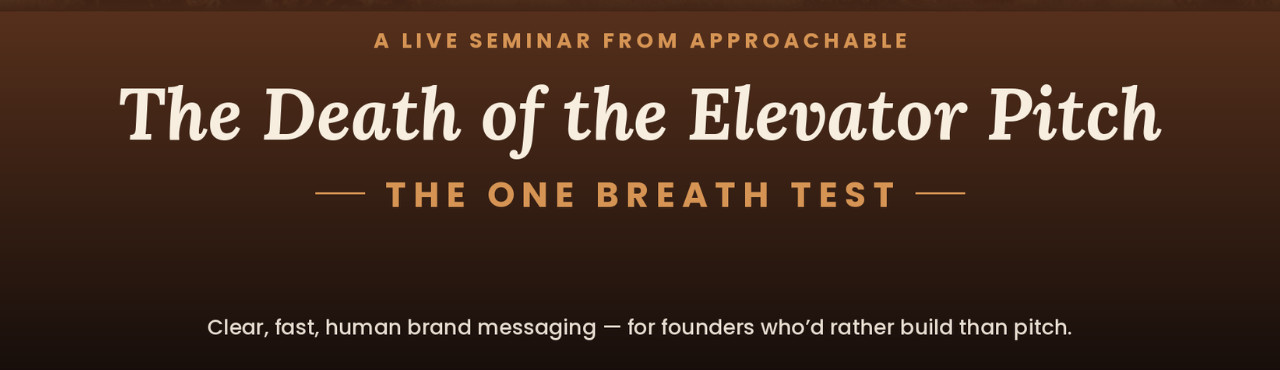
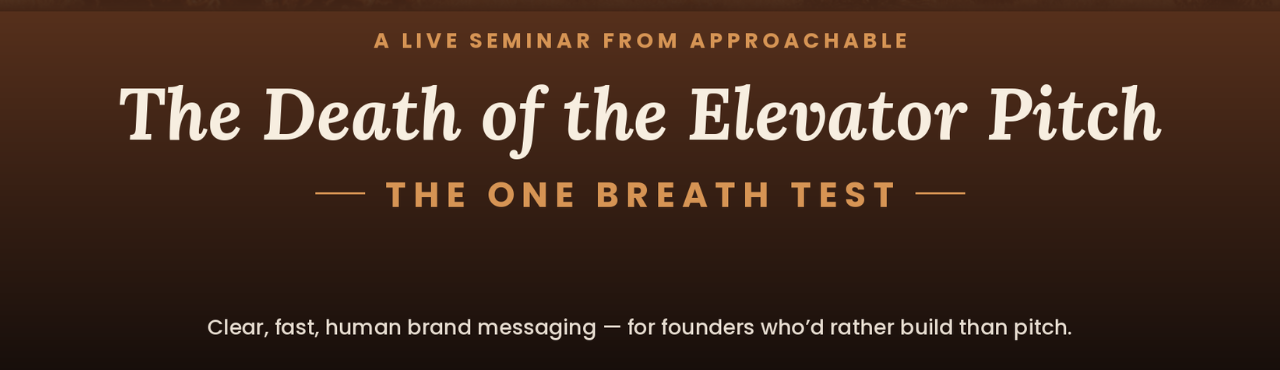
We're running a live, interactive session built entirely around this idea — The Death of the Elevator Pitch: The One Breath Test. We'll put a few brave volunteers through the test live, unpack exactly why most pitches fail it, and walk through the framework for building messaging that's fast and human — the kind that gets repeated at other people's dinner tables, not just nodded at in a pitch meeting.
If you've ever watched someone's eyes glaze over while you were three sentences into explaining your company, this session is for you.
Seats are limited to keep it interactive — register HERE to save yours.