
Data Revenue and Capitalization
Data Revenue: Turning Data Into a Financial Asset
Most organizations know their data has value. The bigger question is: Are they capturing all of that value?
Companies have invested heavily in CRM systems, financial platforms, operational technology, customer databases, analytics, AI, and digital infrastructure. Yet much of the data generated by these investments remains financially underutilized. Organizations often know where their data is and how it supports operations, but they may not know what that data could be worth, who might pay for it, or how it could generate recurring economic value.
This creates an important shift in perspective:
Data should not be viewed solely as an operating resource. It can also be evaluated as a strategic economic asset.
Data Revenue's approach connects three disciplines that are frequently addressed independently:
Valuation + Engineering + Commercialization = Data Monetization
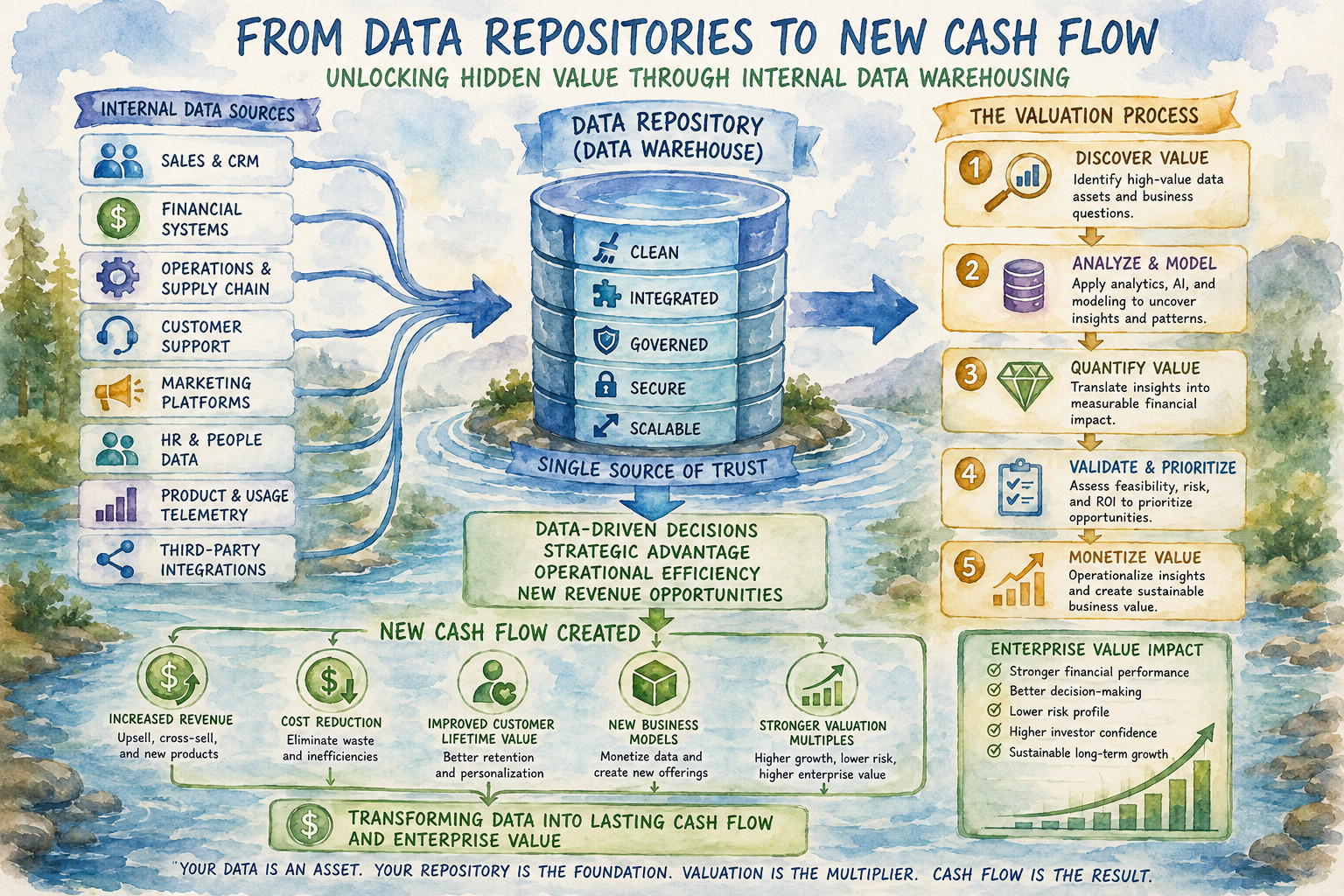
The process begins by identifying what data an organization possesses and where that data creates value. From there, opportunities can be assessed for revenue expansion, cost reduction, customer retention, new products and services, commercial data products, platforms, licensing, and other strategic opportunities.
The distinction is important. Traditional data management often follows:
Collect → Store → Secure → Analyze → Report
Data capitalization introduces another path:
Identify → Value → Engineer → Commercialize → Monetize → Measure
That means moving beyond simply asking what the data tells us and beginning to ask:
What economic opportunities does this data enable?
From Fragmented Data to Economic Value
The opportunity becomes particularly interesting when organizations bring disconnected datasets together.
CRM, finance, operations, marketing, customer support, and product-usage data may each tell only part of the story. When appropriately governed and integrated, those datasets can potentially produce insights and opportunities that individual systems cannot provide independently.
This is where data infrastructure becomes economic infrastructure.
The ultimate objective isn't another dashboard or another report. It is creating a pathway from information to measurable financial outcomes.
That pathway might look like:
Data → Insight → Value → Product/Service → Revenue → Better Data → Better Products → More Revenue
The Question Every Executive Should Be Asking
The conversation around data should move beyond:
“Do you have a data strategy?”
to:
“Do you know what your data could be worth?”
Then:
“Which portions of your data can create measurable financial value?”
And ultimately:
“What would happen if we could identify those opportunities and build a path to monetize them?”
The answer may involve higher revenue, lower costs, improved retention, new products, new markets, commercial data offerings, or increased strategic asset value.
The organizations that gain the greatest advantage may not necessarily be those with the most data.
They may be the organizations that are best at converting their data into economic value.
The First Question Isn't “Can We Sell Our Data?”
It is:
What do we have?
Then:
What is it worth?
Who needs it?
What can it produce?
How can that value become recurring economic value?
Data Revenue is focused on helping organizations answer those questions and build a roadmap from data ownership to data capitalization.
Your data is already generating value. The question is whether you are capturing all of it.
Learn more: DataRevenue.io