
Years ago, I lost a technical project I badly wanted.
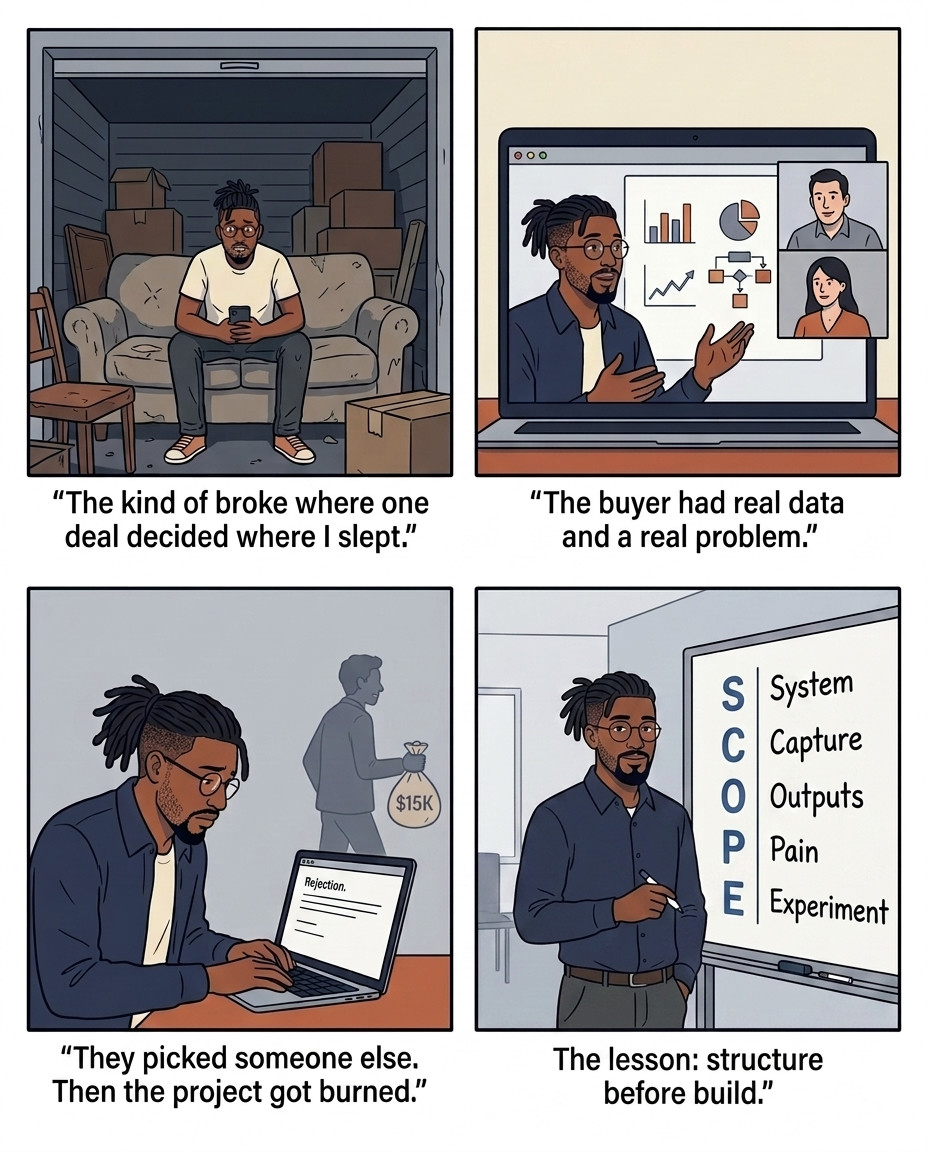
I was broke at the time. The kind of broke where landing that project would have decided whether I slept indoors or on the couch I kept in my storage unit.
The buyer had a real problem: real data, a real business question, a use case that made sense. It was exactly the kind of work I wanted, and they picked someone else.
I tried to be professional about it. Privately, I was crushed.
Months later, the buyer came back. The freelancer they'd chosen had taken about $15,000, billed while learning on the job, failed to deliver, and disappeared. To a funded company, that's not much. For a small nonprofit, it's closer to losing your entire pre-seed budget before you even know if the product can work.
Looking back, I don't think the buyer was wrong to try. The project just needed more structure before anyone touched a keyboard. When a technical project fails early, the answer isn't always to kill the idea. It's to tighten the frame.
These days, before a serious AI or automation project moves into build mode, I want five things nailed down: what system we're improving, what data we're actually capturing, what output the model should produce, where the workflow is really breaking down, and what small experiment would prove this is worth building. I call it a SCOPE pass.
It often reveals the data isn't ready, the workflow was the real problem, or the first version should just be rules-based, not AI.
That's what a bounded feasibility study is for: a controlled first phase that protects everyone from pretending too early, answering what data exists, what output would actually change behavior, and whether the honest call is go, no-go, or re-scope. The old project skipped exactly that step. The real question was never who can build this cheapest. It was who can help us structure this so we know if it should be built at all.
I see the same pattern today across AI, automation, and healthcare workflows. A demo excites everyone, a team assumes the data is ready, a vendor sells confidence, and the real questions show up too late: is the data complete, who acts on the output, what happens when it's wrong.
Skip those questions and the project doesn't become innovative. It becomes expensive theater, and in regulated environments, that theater costs a lot more.
The cheapest vendor isn't always the one with the lowest quote. Sometimes the most expensive person in the room is the one who hands you confidence before they hand you control.
If a project of yours went badly, don't assume the idea was wrong. Tighten the scope, look hard at the data, name the actual pain point. Then decide whether to build.
Before you build AI, make sure the project has enough structure to survive contact with reality.
#healthcareai #medtech #productstrategy #beforeyoubuildai #decisionsystems